Project Background & Personal Journey
This project was motivated by the growing challenges in managing water resources efficiently, especially water loss caused by undetected leaks, poor monitoring, and delayed response. Existing systems often depend on manual checks and lack real-time visibility, which leads to excessive wastage and slow maintenance.
During this project, I explored how sensor data, automation, and mobile applications can work together to improve water management. I focused on designing an application that clearly presents critical information such as water flow status, leak alerts, GPS-based locations, and water quality readings.
This journey helped me move beyond just building a system to thinking about usability, clarity, and real-world impact. It strengthened my ability to translate engineering concepts into meaningful user experiences and deepened my interest in designing solutions that solve practical problems while contributing to sustainability and public welfare.
Problem
Water distribution systems suffer from significant water loss due to undetected leaks, delayed response, and inefficient monitoring. Most existing systems rely on manual intervention and lack real-time visibility of water flow, quality, and fault location. Poor communication between users and authorities further delays repairs, leading to water wastage, service interruptions, and increased maintenance challenges.
Research
Smart Water Management App is designed based on an Arduino-powered system that monitors real-time water flow, detects pipeline leaks, tracks water quality using a TDS sensor, and identifies leak locations through GPS. The app notifies municipal officers instantly, allows remote motor control to stop water flow during leaks, and enables users to register and track complaints, helping reduce water loss and improve efficient water distribution.
User Survey
The user survey focused on understanding challenges faced by residents and authorities in managing water supply systems. Most users reported frequent water leakage issues, delayed repairs, and difficulty in informing authorities about problems. They also expressed concern over water quality and the lack of transparency in knowing supply status.
Authorities highlighted challenges in locating leaks accurately and responding quickly due to missing real-time data. Both groups emphasized the need for a simple mobile application that provides real-time alerts, leak location details, water quality information, and a clear complaint-tracking system.
Survey Overview
Key Survey Findings
experience irregular water supply
unaware of leakage until it becomes severe
face delays in issue resolution from authorities
want real-time updates on water availability
interested in monitoring water quality (TDS levels)
prefer a mobile app to report issues easily
User Insights
Key Insights
- Users lack real-time visibility of water systems
- There is a strong need for quick issue reporting
- Delayed responses create frustration and water wastage
- Users prefer simple and accessible interfaces
- Awareness of water quality is becoming important
Key Takeaways
Card Sorting & Affinity Mapping
To better understand how users interact with water management systems, I conducted card sorting and affinity mapping exercises. These activities helped identify how users group features such as monitoring, alerts, reporting, and control, along with the challenges they face in managing water usage and detecting issues.
The findings ensured intuitive navigation, logical categorization, and a streamlined user flow, reducing confusion and aligning the system design with real user needs, behaviors, and expectations.
Pain Points
- Irregular supply
- Leakage unnoticed
- Delayed response
- No monitoring
- Water wastage
- Manual checking
- No alerts
- Poor communication
- Quality unknown
- Data unavailability
- Time consuming
- System inefficiency
- Lack control
- Issue tracking
- User dependency
Behavioral Points
- Manual checking
- Complaint raising
- Authority contacting
- Water storing
- Usage monitoring
- Issue ignoring
- Late reporting
- Physical inspection
- Tank checking
- Community sharing
- Repeated followup
- Resource saving
- Problem reacting
- Limited awareness
- Daily observing
Desire Points
- Real-time monitoring
- Leakage alerts
- Quick response
- Easy reporting
- Quality tracking
- Data visibility
- Smart control
- Automated system
- Efficient management
- Time saving
- Water conservation
- Simple interface
- Instant updates
- Reliable system
- Stress free
Meet the Users: Personas, Task Flows, Journeys
In preparation for designing the Smart Water Management System, I explored real-life scenarios by interacting with users who directly deal with water usage and management challenges. This included discussions with residents and guidance from my project mentor, which helped me understand both user-level and system-level perspectives.
These insights allowed me to create meaningful personas representing different stakeholders in the system. The insights I gathered helped me develop 3 personas:
Teja
The Smart Resident
Madhav
The Community Member
Annesh
The System Guide
Teja - The Smart Resident
Goals
- Monitor water usage
- Get leakage alerts
- Ensure water quality
Frustrations
- No real-time data
- Late issue detection
- Manual dependency
Behaviors
- Checks water regularly
- Reports issues
- Uses mobile apps
Needs
- Real-time updates
- Easy reporting
- Smart monitoring
Madhav - The Community Member
Goals
- Ensure consistent supply
- Avoid wastage
- Resolve issues quickly
Frustrations
- Irregular supply
- Delayed responses
- Lack of communication
Behaviors
- Stores water
- Contacts authorities
- Shares issues locally
Needs
- Reliable system
- Quick response
- Clear information
Annesh - The System Guide (Mentor)
Goals
- Build efficient system
- Ensure proper data flow
- Improve reliability
Frustrations
- System complexity
- Integration challenges
- Hardware limitations
Behaviors
- Analyzes system
- Guides implementation
- Suggests improvements
Needs
- Scalable solution
- Clear system design
- Efficient architecture
Block Diagram & Working Process
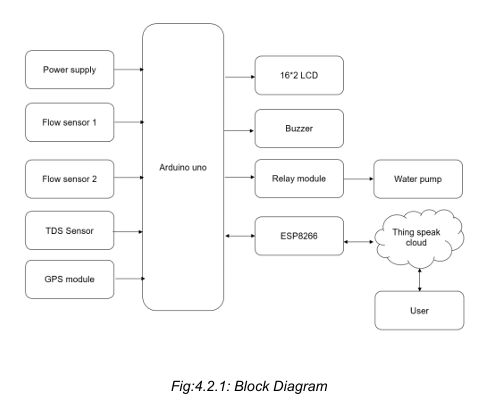
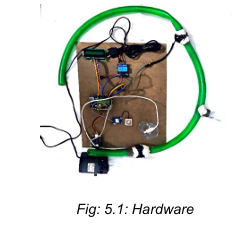
The Smart Water Management System integrates various components to efficiently monitor and control water flow and quality. At the core is the Arduino Uno, which processes data from multiple sensors and manages connected devices. Two flow sensors monitor water flow rates, while the TDS sensor evaluates water quality. The GPS module provides precise coordinates for efficient maintenance. Real-time data is displayed on an LCD and transmitted via Wi-Fi to the cloud and mobile application.
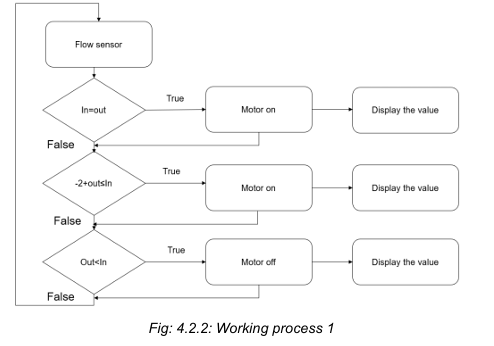
The process starts with the flow sensor measuring water flow values at the inlet and outlet. The system checks if the values are equal, applies a tolerance range, and automatically turns the motor off and displays values if a significant drop is detected - indicating a leak. This structured logic ensures the motor operates efficiently and prevents water wastage.
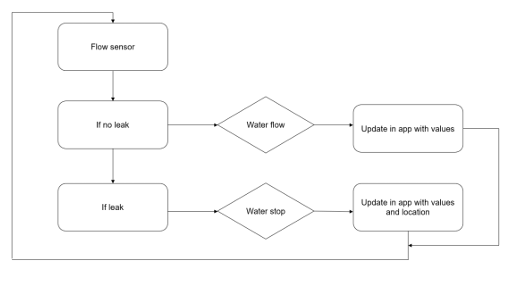
If no leak is detected, the system updates the app with flow values and continues monitoring. If a leak is detected, the system identifies a water stop condition, updates the app with values and the leak's GPS location, and loops back for continuous observation - combining real-time monitoring, data updating, and alert mechanisms.
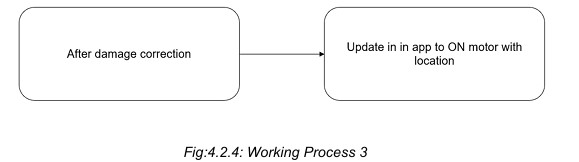
Once the damage is repaired, the system updates the app with the motor's ON status, the location of the correction, and TDS values - ensuring the system resumes normal operation while providing essential data for monitoring water quality and system functionality.
Data Collection
The system collects real-time data from multiple sensors integrated with the Arduino controller. Flow sensors continuously measure inlet and outlet water flow to detect leaks, while the TDS sensor monitors water quality levels.
A GPS module captures the exact location of detected issues. This sensor data is transmitted via a Wi-Fi module to the cloud and mobile application, where it is stored and displayed for users and municipal authorities.
The collected data supports real-time monitoring, alert generation, complaint tracking, and analysis of water usage patterns for better decision-making.
Data Analysis & Results
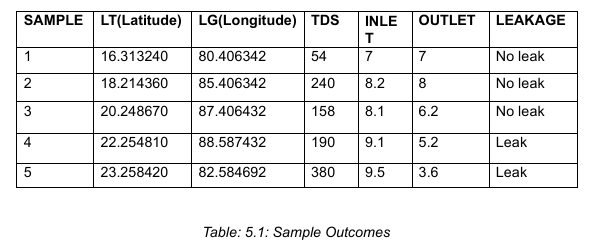
The collected sensor data shows clear differences between normal water flow and leakage conditions. When inlet and outlet flow values are almost equal, the system identifies normal operation. In cases where a significant drop is observed, the system detects a leak and automatically stops the motor to prevent water wastage.
TDS values vary across locations, highlighting changes in water quality. GPS coordinates captured during leakage events help accurately locate the affected area, enabling faster response by authorities.
Design Decisions
Real-time alerts: Prioritized to ensure immediate notification during water leakage or abnormal flow conditions, helping authorities take quick action and reduce water wastage.
Highlighted key metrics on the dashboard: Critical data such as inlet-outlet flow values, leak status, TDS levels, and motor status were highlighted for quick understanding without cognitive overload.
Simple motor control & status indicators: Motor ON/OFF controls were kept simple to avoid confusion during emergency situations and enable fast, error-free decision-making.
Solution Overview
The solution is a Smart Water Management system that combines an Arduino-based hardware setup with a user-friendly mobile application. Flow sensors continuously monitor inlet and outlet water flow to detect leaks, while a TDS sensor tracks water quality in real time. When abnormal conditions are detected, the system automatically stops the water motor and sends instant alerts to the app.
GPS integration provides the exact location of the issue, enabling faster maintenance. The app also allows users to raise complaints and authorities to remotely control the motor, creating an efficient, centralized solution to reduce water wastage and improve response time.
Usability Testing
Test Persona - Ramesh – The Daily User
Goals
- Check water availability quickly
- Report issues easily
- Get updates without effort
Frustrations
- No real-time information
- Complicated interfaces
- Delayed issue resolution
Behaviors
- Quickly scans information
- Uses mobile for updates
- Reports issues when necessary
Needs
- Simple dashboard
- Clear alerts
- Fast interaction
Usability testing was conducted using an interactive prototype. Users were asked to perform key tasks such as checking leak status, viewing water quality data, locating issues on the map, and controlling the motor. The testing showed that users could easily understand the dashboard and complete tasks with minimal guidance.
Feedback helped refine icon clarity, improve status labels, and simplify navigation. These iterations ensured the app remains intuitive, efficient, and easy to use for both users and authorities.
Results & Impact
The Smart Water Management system successfully detected water leaks in real time and reduced unnecessary water loss by automatically stopping the motor during abnormal conditions.
GPS-based location tracking enabled faster identification of leakage points, improving maintenance response time. Continuous water quality monitoring increased transparency and safety for users.
The mobile app improved communication between users and authorities by providing clear alerts, live data, and complaint tracking. Overall, the solution demonstrated improved efficiency and a more reliable approach to sustainable water management.
User Interface Design
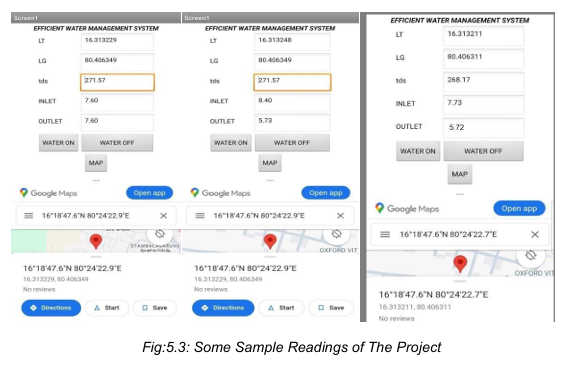
The user interface was designed with a focus on clarity, simplicity, and quick decision-making. A clean dashboard presents critical information such as inlet-outlet flow values, leak status, TDS levels, motor state, and GPS location without clutter. Visual indicators and clear labels help users instantly understand system status, especially during emergency situations.
Navigation was kept minimal to reduce cognitive load, while action buttons like motor control and map view were made easily accessible.
This Project Taught Me
This project taught me how to transform complex technical data into a clear and usable digital experience. I learned the importance of designing for real-world constraints such as time-critical alerts, system reliability, and user clarity during emergencies.
Working on this project strengthened my ability to think from both a system and user perspective, balance functionality with simplicity, and design interfaces that support quick decision-making. Most importantly, it helped me understand how thoughtful design can create practical impact and contribute to sustainable solutions.